Work and teams
What belongs in an equipment service record?
The repair is finished, but the next question may arrive weeks later: Which unit was serviced? What was replaced? Is another visit needed? A short service record can answer those questions when the person who did the work is unavailable.
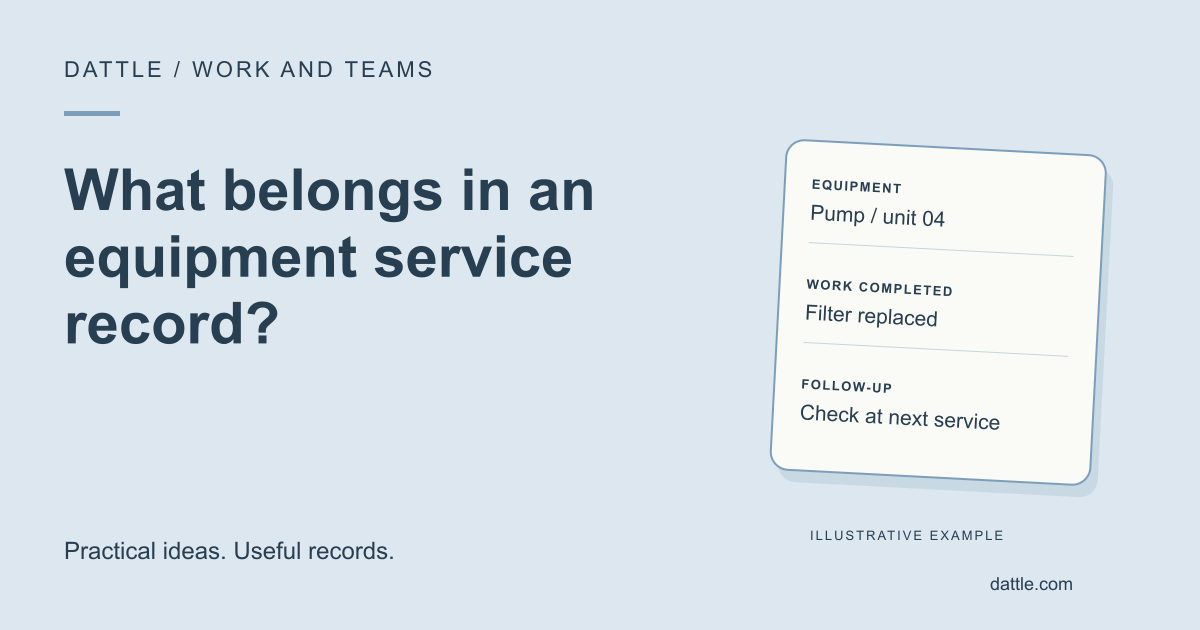
Start with a stable equipment identifier
Use an equipment code that stays with the item when it moves. A location is useful context, but “the vacuum in the corner” can become ambiguous when equipment is rearranged or another unit arrives.
Keep the same code across inspection, repair, and replacement entries. Add a familiar name in the notes if it helps readers recognize the item, while retaining the identifier that connects its history.
Describe the work that actually happened
Record the service type, who performed it, and a concise description of the completed work. “Filter replaced and hose connection checked” is easier to interpret than “serviced.”
Keep an unresolved observation separate from the completed work. If a part is still needed or another check is planned, say so explicitly. A completed service entry can contain an open next step.
A record that supports a handover
The following example uses fictional equipment and costs. It preserves the details someone would need when reviewing the next service entry.
| Detail | Example |
|---|---|
| Equipment | DEMO-VAC-014 / shop vacuum |
| Service date | October 8 |
| Completed work | Replaced filter; checked hose connection |
| Performed by | Demo technician |
| Cost | USD 18 — filter only |
| Next step | Review filter condition at the next planned inspection |
Explain costs and dates
Say whether cost covers parts, labor, or the total service. Keep the currency consistent. An unexplained amount is difficult to compare with a later entry that includes a different scope.
Distinguish the date of completed work from a next service date. If you enter records later, add a service-date field or include the actual event date in the notes so the record’s creation date is not mistaken for the service date.
Attach evidence with context
A photo can show a replaced part, a label, or the condition left after work. Give the surrounding note enough detail to explain what the photo is meant to show.
When taking readings, retain the unit, instrument or device, and operating conditions. Readings taken with different methods may not be directly comparable, even when the numbers appear in the same field.
Build the service history in Dattle
The Maintenance template includes Equipment Code, Service Type, Motion / Vibration, Technician, Cost ($), Next Service Date, Photo, and Notes. Leave measurements blank when none were taken and use Notes to describe completed work.
The illustrated equipment-maintenance walkthrough offers a custom layout with a dedicated Service date field. Both approaches can support a useful history; choose the fields that match how your team records work, then agree on names, units, and responsibilities.
KEEP IT SIMPLE
Your starting checklist
- Use a stable equipment code.
- Describe completed work specifically.
- Record unresolved work as a clear next step.
- Explain the scope of costs and dates.
- Keep measurement units and photo context.