Work and teams
Who has the drill? Keep a useful equipment checkout log
Shared equipment is easy to lose track of when a tool moves between people, rooms, and jobs. A checkout log gives each movement a record. The useful question is simple: what happened to this item most recently, and what was recorded with that handover?
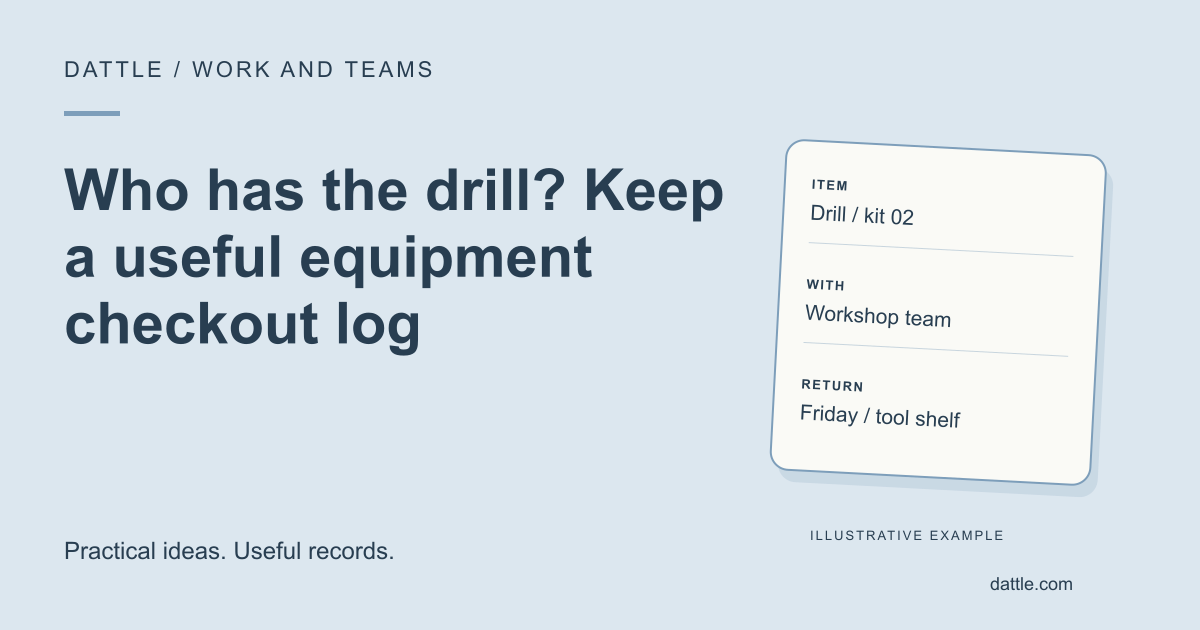
Give every movement its own entry
Create an entry for a checkout, another for a transfer, and another for a return. Keeping each transaction preserves the earlier handover instead of replacing it with the latest person’s name.
Decide what the log covers before starting. A drill kit can have one equipment code if the drill, case, and accessories travel together. Parts that circulate separately may need their own identifiers.
Capture the details people need at handover
Record the equipment code, who or which team receives it, and the transaction type. Include condition and the accessories present. Use a due date for a checkout and the actual return date for a return.
A note can explain a missing charger, two included batteries, or an agreed storage location. A photo helps when the condition or contents would otherwise be hard to describe.
Read transactions in sequence
These fictional entries show why a transaction history is useful. The second row preserves the transfer without erasing the original checkout.
| Transaction | Assigned to | Handover note |
|---|---|---|
| Checked out | Demo installation team | Case, charger, two batteries. Due October 15. |
| Transferred | Demo workshop team | Same kit received; one battery in use. |
| Returned | Tool store | Kit back in cabinet B; all accessories present. |
Be consistent about condition and accessories
Agree what Good, Fair, Damaged, and Not inspected mean for your team’s records. A specific note helps explain a condition label. Use Not inspected when the condition was not checked.
Select the accessories actually handed over. If a category such as Battery could mean one or several, add the quantity in Notes. This keeps a later disagreement from depending on an ambiguous selection.
Check the latest relevant transaction
Search by equipment code and review the sequence before deciding who currently has the item. An older checkout can still be in the history after a later transfer or return.
Record transactions promptly. If entering a past handover, preserve its event date in a field or note. The timestamp of a late entry may otherwise make the sequence look different from what happened.
Use Equipment Checkout in Dattle
Equipment Checkout includes Equipment Code, Assigned To, Transaction, Condition, Accessories, Due / Return Date, Photo, and Notes. A Shared Dattle lets people contribute handover records using a common field layout.
The log records the transactions people enter. Agree who records each handover and how discrepancies are resolved, then test the process with one kit before extending it to every shared item.
KEEP IT SIMPLE
Your starting checklist
- Give equipment a stable code.
- Create a new entry for each transaction.
- Record condition and included accessories.
- Clarify quantities and event dates in notes.
- Read the transaction sequence before identifying the current holder.