Personal life
Build a home inventory one cupboard at a time
A home inventory can feel like a project that requires an entire weekend. It can also start with a single shelf. A small, current list becomes useful as soon as it helps you find an item, identify its model, or remember where its accessories are kept.
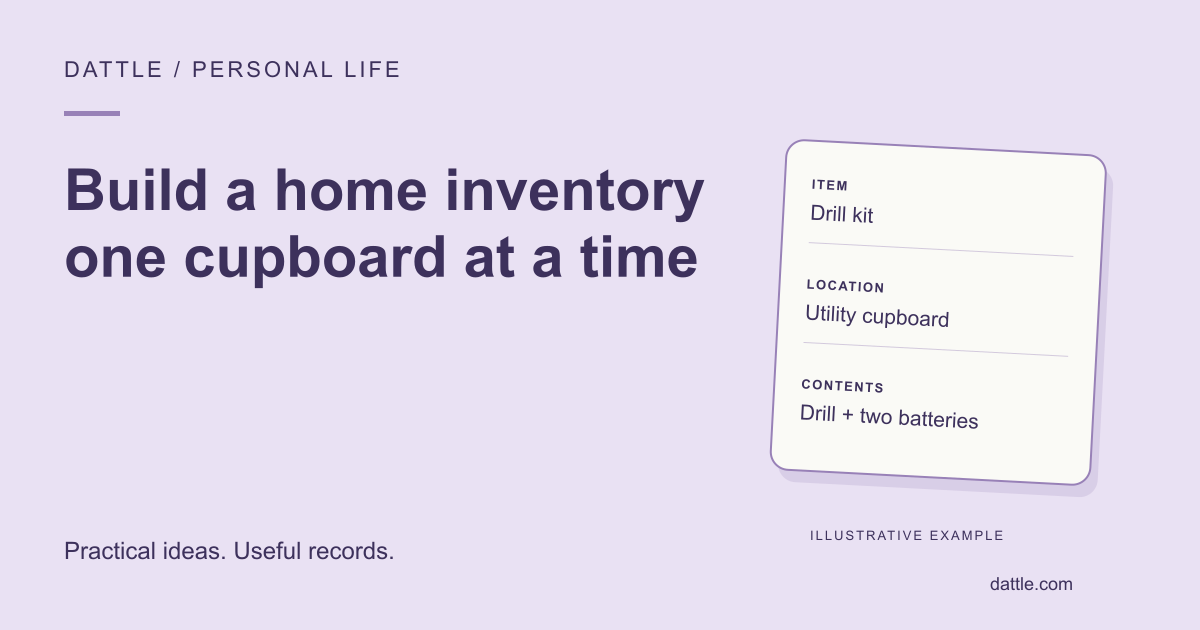
Choose a small, useful area
Begin with a cupboard, drawer, or tool shelf whose contents you often need to find. Finish that area before expanding the project. The boundary gives you a clear stopping point and makes it easier to return later.
Decide what counts as one item. A drill and its batteries might be a kit if they always stay together. If batteries move between tools, separate entries may make more sense. Use a level of detail that matches how you handle the objects.
Capture details that answer a future question
Record a recognizable item name and enough identifying information to distinguish it from similar objects. A model or serial identifier can be useful when finding a manual. A room, cabinet, or box label helps locate it.
A photo should make identification easier. Consider one view of the object and a readable label when those serve different purposes. Note where the manual or accessories are stored so the record covers the whole kit.
A record for one tool kit
This fictional entry is specific enough to help someone find the kit and understand the value recorded with it.
| Detail | Example |
|---|---|
| Item | Cordless drill kit |
| Identifier | SAMPLE-0012 |
| Location | Garage / cabinet B / drawer 2 |
| Included | Drill, charger, two batteries |
| Value | USD 79 — purchase price |
| Photo | Kit and identifying label |
Explain quantities and values
Preserve letters and leading zeros in identifiers. If you enter a value, state what it represents: for example, the price paid at purchase. Use a consistent currency, and leave unknown details blank until you can verify them.
When a kit has several parts, list what is included instead of assuming a photo will explain it. The note will still be useful when the photo is small or one accessory is out of view.
Update the record when an item moves
Use a move, sale, or replacement as the prompt to update the inventory. Revisit the existing entry so there is one clear current location. If you also want a borrowing history, keep separate checkout records for each loan and return.
For a shared household list, agree on location names. “Hall closet / upper shelf” gives another person a better starting point than “usual place.”
Start with Home Inventory in Dattle
The Home Inventory template includes Item, Barcode / Serial, Category, Value ($), Photo, and Notes. Use Notes for room, model, accessories, and the meaning of the value. You can adjust the setup if a separate location field would help.
Add your first few items, then search for one by name or identifier to check that the record answers the questions you intended. The linked template guide walks through the fields and a complete fictional entry.
KEEP IT SIMPLE
Your starting checklist
- Pick one shelf, cupboard, or drawer.
- Decide whether kits need one record or several.
- Capture an identifier and a current location.
- Explain what any recorded value means.
- Update the entry when the item moves.