Field notes
What to record in your garden for next season
Next season, you may remember that something grew well without remembering which bed it occupied, when you changed its care, or what “well” looked like. A small record made at the time can preserve those details. The trick is choosing questions your future self will actually ask.
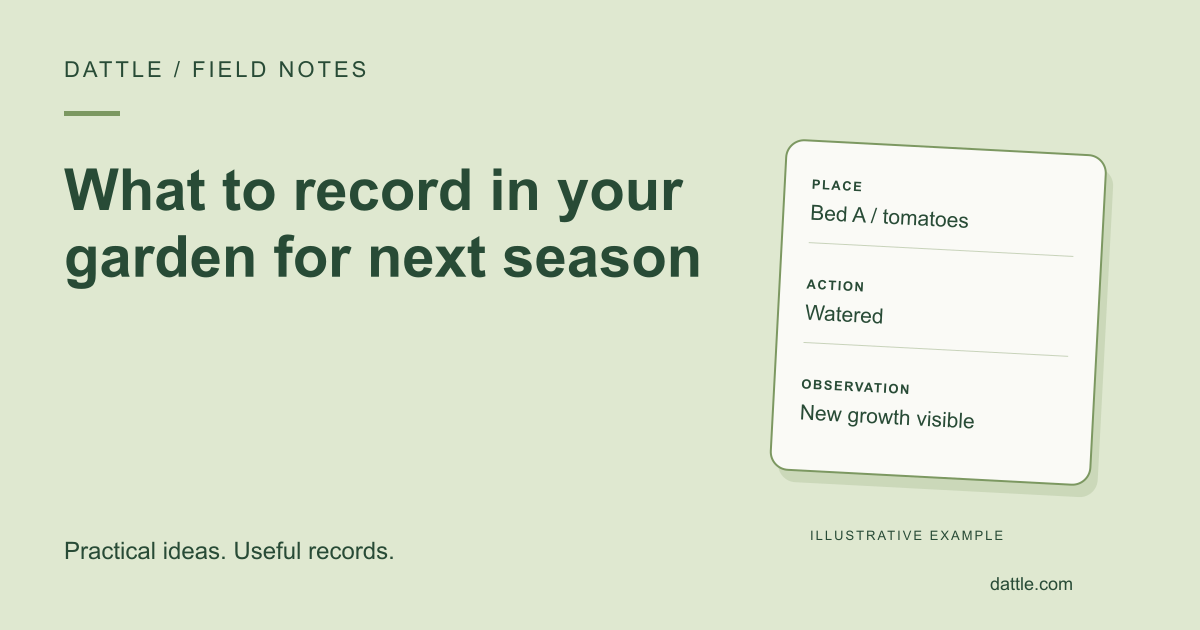
Start with the question you want to answer
Choose one question for your first set of records: Which container needed the most attention? What did this bed look like before harvest? Which variety would I grow again? That question tells you what a useful entry needs.
For a care history, record an action each time you water, prune, or repot. For an observation diary, record what you see on a repeat visit. You can keep both, but name the activity so a later reader can tell a task from an observation.
Give each plant or bed a stable name
“Tomatoes” may be enough when there is one pot. If there are several, use a name such as “Bed A / cherry tomatoes” and repeat it exactly. A location label connects entries across a season, even as the plant itself changes.
Add the variety when it matters to your question. Keep a date for the actual event when entering a note later; the day you typed the entry may be different from the day you harvested or repotted.
One observation can be enough
This fictional record keeps the activity separate from what was observed. It gives the next entry something concrete to refer back to.
| Detail | Example |
|---|---|
| Plant or bed | Rosemary / patio pot |
| Event date | October 8 |
| Action | Watered |
| Observation | Soil surface dry before watering; new growth visible. |
| Photo | Same view of the pot and leaves as last week. |
| Next comparison | Look for changes in the new growth on the next visit. |
Make comparisons easy to interpret
Photograph a similar view on repeat visits. A close-up can capture a leaf detail, while a wider view shows which plant and pot it belongs to. When you measure something, keep the unit beside the value.
If you record harvest amounts, use one unit consistently or state the unit in each entry. Keep an unmeasured harvest blank. A zero should mean you actually recorded none, rather than that you forgot to weigh it.
Choose a routine you can keep
Start with one bed or a few plants. Write a short entry after the activity you want to remember, then review a handful of entries at a convenient interval. If a field is always left empty and does not help answer your question, reconsider whether you need it.
When someone else helps, agree on plant names and units together. Include enough context that either person can understand an entry without asking who wrote it.
Put the approach into Dattle
The Garden Log template includes Plant Name, Action, Health, Ambient Light, Photo, and Notes. It suits a care history. Plant Journal focuses on photo observations, habitat, and location. The linked guides show the exact starting fields and example entries.
Use the custom garden-journal setup when you want your own event date, harvest amount, and unit fields. Start with the layout that fits your question, then adjust it as you learn which notes are useful.
KEEP IT SIMPLE
Your starting checklist
- Choose one question for the season.
- Use consistent plant or bed names.
- Separate what you did from what you observed.
- Keep measurement units and relevant event dates.
- Review a few entries before adding more fields.